
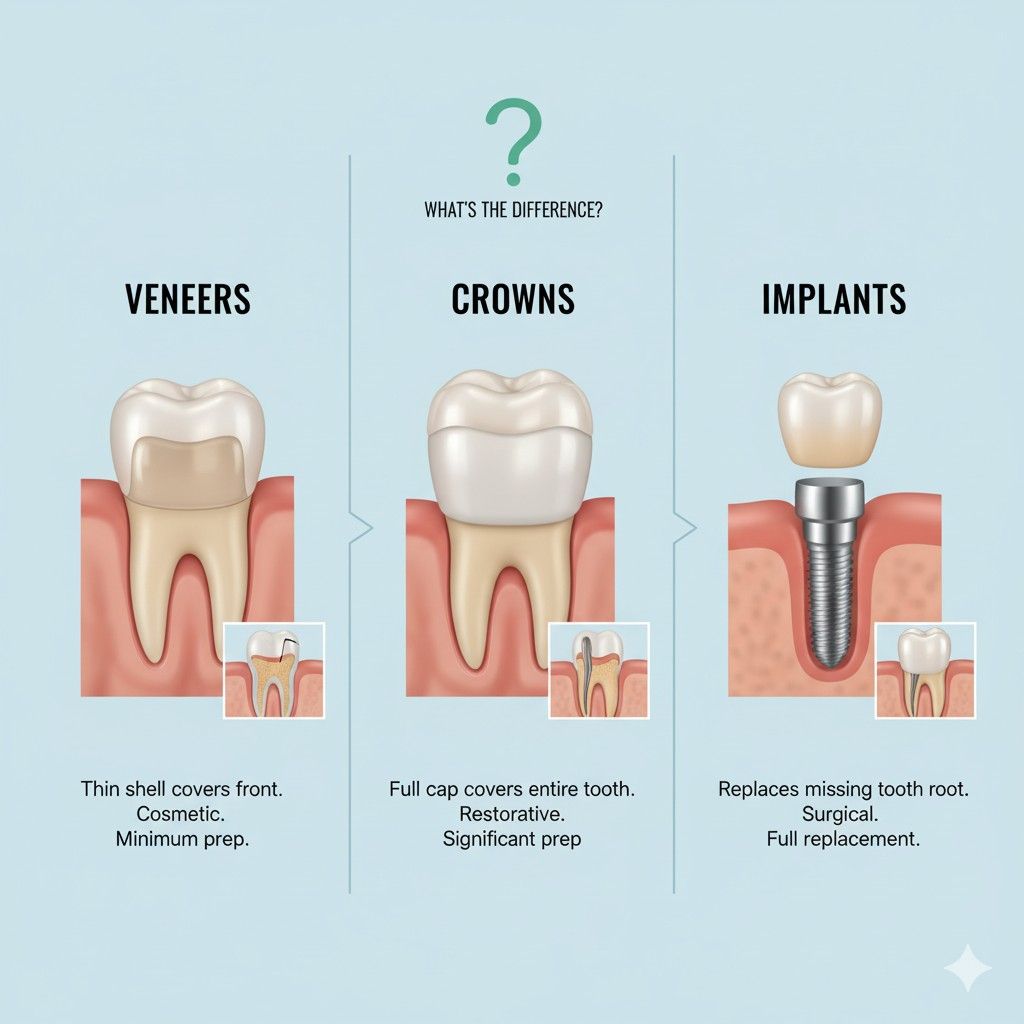
What’s the Difference Between Veneers, Crowns, and Implants?
When it comes to restoring or enhancing your smile, dental technology offers a range of options — each designed for specific needs. At King and Weston Dental, we often help patients understand the differences between veneers, crowns, and implants, and how to choose the right solution for their teeth.
Whether your goal is to improve aesthetics, strengthen damaged teeth, or replace missing teeth, knowing the differences between these treatments is the first step toward a confident smile.
Dental Veneers: Cosmetic Enhancements for Your Smile
What Are Veneers?
Veneers are thin shells of porcelain or composite resin that are bonded to the front surface of your teeth. They are primarily used to improve the appearance of teeth rather than restore significant function.
Veneers can:
- Cover discolored or stained teeth
- Correct minor gaps or uneven spacing
- Improve the appearance of slightly chipped or worn teeth
- Enhance the overall shape and symmetry of your smile
When Are Veneers Recommended?
Veneers are ideal for patients with teeth that are healthy but aesthetically imperfect. If your teeth are structurally sound but you’re unhappy with their color, shape, or size, veneers can create a dramatic transformation with minimal tooth removal.
Key Advantages
- Natural-looking: Porcelain veneers closely mimic the translucency and color of natural teeth.
- Stain-resistant: They resist most everyday stains.
- Minimal invasiveness: Only a small portion of enamel is removed to bond the veneer.
Dental Crowns: Strength and Protection
What Are Crowns?
Crowns, sometimes called caps, are custom-made coverings that encase the entire visible portion of a tooth. Unlike veneers, which only cover the front surface, crowns protect teeth that are weakened, cracked, or heavily filled.
Crowns can be made from:
- Porcelain or ceramic (for a natural look)
- Metal alloys (for strength, often on back teeth)
- Porcelain-fused-to-metal (a combination of durability and aesthetics)
When Are Crowns Recommended?
Crowns are commonly used for:
- Teeth with large cavities or fillings that compromise strength
- Cracked, broken, or worn teeth
- Root canal-treated teeth, which become more fragile after treatment
- Cosmetic improvements where veneers are insufficient
Key Advantages
- Full coverage protection: Shields weakened teeth from further damage.
- Restores function: Crowns allow patients to bite and chew normally.
- Durable: With proper care, crowns can last 10–15 years or more.
Dental Implants: Permanent Tooth Replacement
What Are Implants?
Dental implants are surgical solutions for missing teeth. They consist of three main components:
- Titanium post: Surgically placed into the jawbone to act as a root.
- Abutment: Connects the post to the replacement tooth.
- Crown: The visible tooth restoration that sits on top of the abutment.
Unlike crowns and veneers, implants are used to replace teeth entirely, not just restore or improve existing ones.
When Are Implants Recommended?
Implants are ideal for patients who:
- Have one or more missing teeth
- Want a permanent alternative to dentures or bridges
- Have healthy gums and sufficient bone density
- Seek a solution that looks and functions like natural teeth
Key Advantages
- Permanent solution: Implants can last decades with proper care.
- Bone preservation: Implants stimulate the jawbone, preventing bone loss after tooth extraction.
- Natural appearance and function: They blend seamlessly with surrounding teeth and restore full chewing power.
Comparing Veneers, Crowns, and Implants
| Feature | Veneers | Crowns | Implants |
|---|---|---|---|
| Purpose | Cosmetic enhancement | Strengthen/protect damaged teeth | Replace missing teeth |
| Coverage | Front surface only | Entire tooth | Entire tooth, including root (via implant) |
| Procedure | Minimal enamel removal, bonding | Tooth reshaping, cemented over tooth | Surgical placement in jawbone, followed by crown |
| Longevity | 10–15 years | 10–15 years | 20+ years, often lifelong |
| Best For | Discolored, chipped, or slightly misaligned teeth | Weak or damaged teeth | Missing teeth or severe tooth loss |
Choosing the Right Option
The best choice depends on your oral health, goals, and budget.
- Choose veneers if your teeth are healthy but you want a more aesthetic smile.
- Choose a crown if you need to protect a tooth that’s damaged or weakened.
- Choose an implant if you’re missing a tooth entirely and want a permanent solution.
At King and Weston Dental, our team provides a thorough evaluation, including digital imaging and consultations, to help you select the treatment that’s right for your smile.
The Takeaway
Veneers, crowns, and implants each play an important role in modern dentistry, but they serve different purposes. Veneers enhance appearance, crowns protect and restore function, and implants replace missing teeth permanently. Understanding the differences ensures you can make informed decisions about your oral health and smile.
If you’re considering improving or restoring your teeth, the experts at King and Weston Dental are here to guide you through every step — from consultation to completion — ensuring your smile is both healthy and beautiful.
Schedule your appointment today to explore your options and discover which solution is best for your unique dental needs.